Friday, 22 July 2011

Rene Magritte : Art evokes the mystery without which the world would not exist.

Rene Magritte : The Pleasure Principle, Liverpool Tate.

Rene Magritte was a Belgium surrealist painter involved with the fauvist movement, he was most renowned for his imagery that mixes banal objects in a bizarre way to create an immediate impact on the viewer, which is mysterious and takes time to investigate and explore further.

He did this by his innovative use of layering different textures, surface pattern, veiling imagery, repetition, and using paradoxical realities as seen in 'Day and Night' showing a juxtaposition of night and day.

The exhibition at the Liverpool Tate was set in eight rooms leading on from one another, it acted as a visual representative of Magritte's artistic timeline. All the rooms were minimal in design with the paintings hung side by side as in an drawing room, only one or two of the paintings had rope around them to section them off. The curator Christoph Gruenberg focused the viewers attention to certain pieces by placing an individual bench in front of  a painting, this suggested that it needs examining further or in some way is seen as more special and intriguing.

As you enter each room there is a written full description of the purpose of the room and the contents its contains. The description coupled alongside texts by certain images acts as a role of the museum guide in informing the visitor about the structure and history of the exhibition pieces. In the third room it acts as a resting point, so you can gather your thoughts, as there is a television showing a documentary on Magritte, there is no accompanying sound but it allows the visitor to contextualise the art work by studying Magritte and what he looked like.

A few of my favourite pieces from the exhibition -

The Lovers, 1928.


It represents unfathomable isolation by the faces being covered by a dirty looking rag, despite their intimate embrace. This acts as a reflection on the modern day couple as it insinuates that no matter how close one seems to be with a partner, there is something that self consciously restricts full commitment and holds you back, which is seen by the covering of the face.


The birth of the Idol, 1926.


It is representative of an materialistic society, by being named the birth of the idol it makes reference to the settings of 1920s when painted and when celebrity culture was becoming well known, such as flappers and designer Coco Chanel. The crashing waves and diving board in the shape of a person reflect a disjointed society,  the symbolism of the diving board and  instead not a person jumping off, acts as a metaphor that shows people's loss of curiosity by not looking over the edge, and instead being interested in others peoples endeavours, again reference to being named 'The birth if the Idol.'


Magritte was also interested in examining the relationship between object, representation and meaning, as seen in 'This is a piece of cheese,' and 'La Pipe.' He was most well known for challenging how an object has specific meanings and how these meanings can be changed, as every object has more than one meaning to whoever is interpreting the image. 'An object is never so closely attached to its name that another cannot be found which suits it better.' Magritte.

It is Magritte's involvement with Paul Nouge the leader of the Belgium Surrealist group, that has improved the awareness of the Dada movement and in turn inspired a range of artists such as Andy Warhol. He worked to make a mockery of what museum institutes consider as art, he did this by his use of bold, brash colours in the exhibition Galerie Goemans in Paris which resulted in his estrangement from the Parisian Surrealists.

Magritte was considered a modern artist by his innovative use of layering, and causing people to examine the meaning people give to objects and its banality in the sense as nothing is fixed, as one persons views are different compared to another, so in essence interpretation varies so no which one is set in stone.

'My painting is visible images which conceal nothing, they evoke mystery and, indeed, when one sees one of my pictures, one asks oneself .. 'What does that mean?' It does not mean anything, because mystery means nothing either, it is unknowable.' Magritte.



Sunday, 20 March 2011

I sometimes wear your face as a mask to inspire me

Sunday, 27 February 2011

Robert Mapplethorpe.


Robert Mapplethorpe's work acts as an visual influence on fashion photography today. He originally studied drawing, painting and sculpture before discovering his passion for photography.


Portrait X, Self Portrait, 1978.

His photographs challenged the aesthetic norm in the late 70s by the sitters being socialites, pornographic film stars and members of the S+M underground scene. With his background being in sculpture and the technical aspect of art this influenced his photographs as his images reflected the body as an object not the actual sitter as a person.

It is his De-eroticism of the body that makes his photographs so beautiful and the viewer concentrate on that rather than the content which can be seen by some as 'shocking.' He was well known for his portraits, he had a solo exhibition named 'Portraits,' in the Light Gallery, New York in 1973. His portraits are honest, the sitter's look vulnerable and unstaged.

Untitled, (randy) 1975. 
Untitled, c.1973.

There is currently a Robert Mapplethorpe: Retrospective exhibition running from January 22 - March 27 2011 in Postfuhramt, Berlin. The exhibition contains 187 photos that concentrate on the development of his photographic work. 

Saturday, 26 February 2011

The new gender revoloution

The concept of gender revolution is not a new one Yves Saint Lauren adapted men's tailoring to women's bodies in the infamous 'Le Smoking Woolen Pantsuit,' in 1978. It aided in the liberation of women with the new modern style.

However now in 2011 the concept of gender revolution takes a whole new twist, with the trend of the moment being 'femiman.'

The 19 year old, pre op transgender Andrej Pejic is the model of the moment, signed to Storm modelling agency he is listed to work for both male and female fashion shows.


This season he has worked for Jean Paul Gaultier in the 2011 menswear fashion show in Paris and Gaultier spring/summer 2011 Haute Couture show as the final blushing bride. Which Rhianna then wore at the Grammys.


Also he is the new face for Marc by Marc Jacobs Spring 2011 advertising campaign, photographed by Jeurgen Teller.

His beauty is so exquisite and ethereal it has no consequence to his physical sex. The boundaries of fashion have been blurred. The androgynous look has evolved to the 'femiman' trend and there is no longer a division between male and female just beauty.

Thursday, 24 February 2011

Iki aesthetic ideal

When researching Japanese fashion I came across the notion of Iki. It is a widely used Japanese aesthetic ideal it stems from the human act of appreciating the beauty of nature. The cultural anthropologist Kuki Shuzo wrote thesis on Iki, it originated in the late 18th century by the towns people of Edo. The theory of Iki can be applied to fashion but unlike Western fashion it concentrates on simplicity in design as to sustain physical and emotional distance between the opposite sex, but not completely losing it.

Iki fashion is sophisicated, muted colours and minimalistic. It is a mode of self expression but unlike Western fashion it does not aim to bring attention to oneself, Iki prefers the overtone of the experience rather than the experience itself.
The image above named, 'Mikaeri Bijin,' translated the Beauty who looked back is an example of Iki art. The woman is looking over her shoulder as Iki beliefs say that you should not directly stare at your subject as it is an invasion of privacy and doesn't cohere to the Iki belief of discretion.
Iki is becoming more wideknown by the works of Japenese designers, the simplicity of the fashion design and the reserved beauty of the clothes are becoming the new mode of self expression.

Wednesday, 23 February 2011

Roberto Capucci


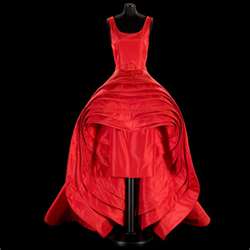
I have just discovered Roberto Capucci whilst I was looking into the debate whether fashion can be seen as art. Roberto Capucci is an Italian designer, he works outside the commercial world of fashion by not conforming to the norm and working on avant garde pieces. He hasn't compromised his artistic vision by making clothes for the mass main stream market. His clothes are works of art in their own rights, the complexity of his designs in creating ingeniously constructed outfits.

The Philadelphia Museum of Art are holding an retrospective exhibition of his work named, 'Art into Fashion,' running from 16th March to 5th June 2011. The exhibition will show a collection of 80 Capucci designs with Dilys Blum as curator.