Wednesday, 17 October 2012

Decorative Arts and History museum, Dublin

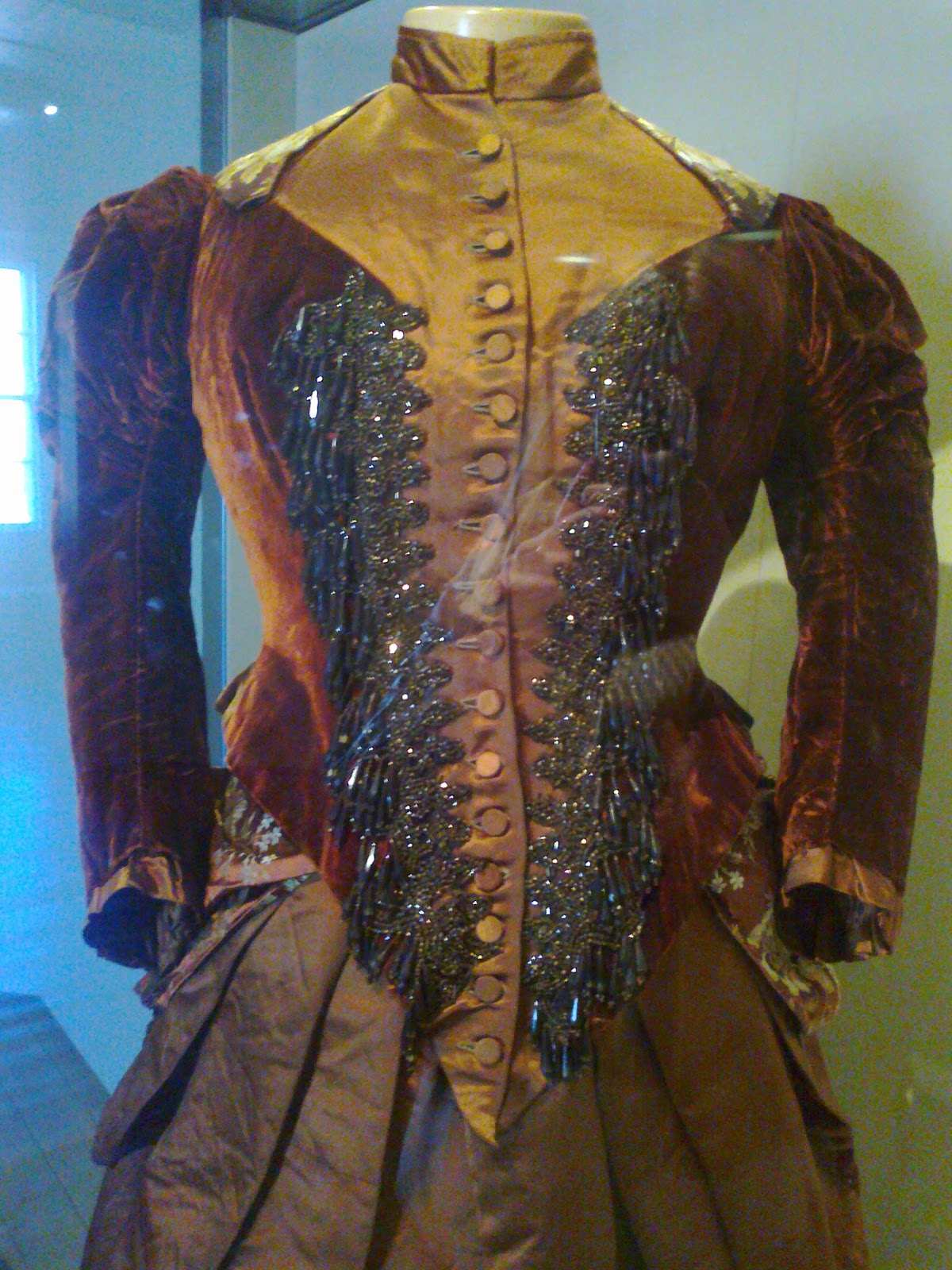
Housed in the Army barracks of the Decorative Arts and History museum is a Charles Frederick Worth (1825-1895) late nineteenth century designed dress for the wife of Lord Mayor of Dublin from 1898 to 1900.

The designs of the time had a Parisian influence with lavish fabrics and took on historical influences with tight corset framing the wearer into hour glass shape which is then supported by crinoline stiff framework underneath the dress to hold characteristic full bell shape. The rear bustle worked by holding the lavish, heavy fabric so it could drape over the back which had opulent feel.

The overall effect of the dress was elaborate and decorative as seen in the baroque inspired corset with opulent beading. The dress was designed to be seen and represent their husband’s wealth.  
It is a good representative of late nineteenth century Parisian design which Charles Frederick Worth was famed for by his couture designs.


Tuesday, 16 October 2012

Ugly shoes the new craze

Ugly shoes the new craze

Next Spring 2013 if what we see on the catwalks is to come to fruition the shoe once seen as a sexy accessory has all gone Pete Tong. Flats are in but not the brogues we saw last season of polished leather giving masculine yet sophisticated feel but weird mixes of fur, plastic and futuristic sheen making next Spring seem set in never reaches of shoe envy.

Phoebe Philo for Celine has made comfy shoes the ones for the season, no longer tired feet from walking on pin point stilettos but shoes have furry lined bottoms in bright, garish Eskimo covered ballet pump style.
Prada’s two tongued plastic flats are the worst offenders for me. Firstly who likes wearing sandals that cut in between your toes and secondly they have plastic sheen to them which no doubt will make for a sweaty mix. Prada also shown wooden platform shoes with circular hole cut out of the platform that I like but it all goes bit strange with metallic ankle covering which looks like a sock wrapped around foot.

There's not much can be said about Marc Jacobs pilgrim style shoe, it looks like it been created by Amish on acid.

So for next Spring I don’t know if I’ll be following these crazy shoe trends I think it may be one left for the catwalk where fashion meets ugly.
 

National Gallery of Ireland

I recentley just visited Dublin and had a wander around National Gallery of Ireland the collection that I most enjoyed was that of Jack B Yeats (1871 - 1957) the Irish impressionist painter. His work is full of expression via his use of vivid colourings, bold brush strokes and romantic connotations. It was housed not in the main gallery section but in corridors running off inbetween rooms it made the collection have its own stance and not comparable to others work. 

About to Write a letter 1935


Men of Destiny 1946
The singing horseman 1949
Grief 1951


Sunday, 14 October 2012

Check out my article for 'ACE Liverpool' an Arts, Culture & Entertainment magazine based in Liverpool.

http://www.aceliverpool.co.uk/setup/?p=928


Tuesday, 9 October 2012

Science inspired garments


Designer Brooke Roberts merged her previous history of working as radiographer with her fashion design and pattern cutting skill to create garments inspired by CT scans and Xrays, she progammed knitting machines to specific patterns to create the garments. I love the merge of science and fashion in her garments in creaing futuristic print. I also like how the garments are knitted it is the mix of knitting and science inspired inspired print which I think is merging old and new techniques. 

Friday, 5 October 2012

Eco Fashion

The growth of eco fashion
Oscar Wilde, ‘Fashion is a form of ugliness so intolerable that we have to alter it every six months.’

The fashion cycle rate of consumption is adversely impacting on the environment in each of its production stages from the cultivation of raw fabric to shipment of finished garment. Eco Fashion formally not widely known by mass market is now becoming more accessible by the work of environmentally conscious designers who use, produce and/or promote sustainable and ethical products.  Gone are the connotations of free love, hemp and earth colourings replaced by the respect for people plus planet plus profit in equal measurements.

The timeline of eco fashion.

Eco fashion can be traced back to the 1950s when the social elite wore couture and others who couldn’t afford to buy would follow the trend by making their own clothes. There was a great emphasis on investment purchases of high quality, long lasting goods they were eco friendly without being aware by their slow rate of consumption.
The natural looks that emerged in the 1960s can be linked to the hippies there was a trend for the re-working of vintage clothing into new garments which embraced creativity and individuality therefore rejecting the dehumanising effects of mass production and consumerism.

The 80s and 90s was a time when truly the effects of mass produced goods became common knowledge in the form of sweatshops catching worldwide attention, which encouraged the public to become more aware of what they’re buying into. Katherine Hamnett was one of the leaders in eco fashion became well known by her 1989 ‘Clean up or die’ Autumn Winter collection in which she used organic cotton on slogan t-shirts. Moschino in 1989 used his reputability as a form of expression by models wearing slogan t-shirts such as ‘stop using our waters as a W.C’ on the runway.
The work of Martin Margiela in the 1990s was that of upside down dysfunctional beauty by his re-working of existing garments by first deconstructing them then reconstructing into new forms, for example jacket made from multiple silk scarves. His ecological approach became known for its avant-garde qualities his garments were viewed as works of art which don’t follow passing fashion trend but instead encourage investment on high quality goods.

The twenty first century saw the introduction of green as the new black as legendary fashion journalist Suzy Menkes said in 2006. The same year ‘Esthetica’ by the British Fashion Council was established to showcase cutting edge designer’s committed to working eco sustainably.
Esthetica S/S 2012 London Fashion Week, Henrietta Ludgate one of the designers was one of my favourites by her use of structured colourful designs. As well as Victim Fashion Street her use of reclaimed materials in reconstruction of garments is skilfully done by mix of print.

In proof that the notion of eco fashion had become well received by mass market came in 2007 when designer Anya Hindmarch released the bag with slogan ‘I’m not a plastic bag’ on and was snapped on arms of many a celebrity and in doing so became the bag of the moment with stocks selling out. Eco fashion is now seen as eco cool.
Now to the science that is needed to inform the continual progress of environmentally conscious garments is still in development some possible new techniques consist of biodegradable clothing which is growing clothes out of biomaterial the bacteri al-cellulose is spun and made into material fibre, literally means the possibility of growing a dress out of science beaker so no resources would be depleted.

Designers Andrew Sneider and Diffus designs have managed to incorporate energy production into garment process by creating a solar bikini and solar panelled hand bag retrospectively. They produce enough energy to charge mobile phone and can act as energy capacitors; we will be our very own walking energy producer.
Another concept to reduce energy usage is being researched into the production of a fabric that has a coating made from compound of titanium dioxide which acts as very own washing machine so reducing energy usage as well as water usage. This compound would have capability of breaking down dirt molecules while killing microbes by being activated by UV rays.

To reduce the amount of fabric waste a concept has been developed which utilises a loom attached to computer that weaves made to fit garment sections which can then be sewn together by hand, therefore no fabric waste so saving on raw material.

Ultimately all these innovations in fabric development are concepts at the moment and to promote eco fashion is down to the consumer as consumers drive fashion by their demands. The appeal of slow fashion which is less driven by current trends but dictated by style and high quality garments is the promotion of an ecologically friendly fashion movement.

Tuesday, 2 October 2012

Tattoos and the self fashioning of identity

Tattoo and identity

Tattooing is a form of self expression in construction of a cultural embodied identity. Tattooing has always been a symbol of identity in that the tattoos of the wearer represent their cultural standing be it the stereotypical notions of prisoners tattoos as they are stripped of any form of identity by the wearing of uniform prison jump suit, so their tattoos show their cultural position and act as expression of identity that not allowed to express in form of clothing.

But what when tattoos surplus the mode of expression that clothing entails and takes its own expression of identity that no longer does a person who have a tattoo is immediately classified as member of deviant social group. Tattooing is now seen as art form and the actual tattooist as contemporary artist with the body as medium instead of traditional canvas. Tattoos now are no longer individual symbols of self identity but can work as a coherent piece of art work; it is a combination of owners identity mixed with tattooist’s vision that creates individual art work that becomes a talking point and representative of the owner.

The twenty first century is an image obsessed, over saturated society in which images are over consumed via media outlets. Brands have signifying identity traits which we as the public signify with certain brands and the related aspects of status and identity. Artist Dietrich Wegner highlights this with his use of babies covered in fake tattoos of corporate brand logos, it aims to show the world in which they will be brought up in. Therefore the want of people to distinguish themselves by forms of tattoos is growing in the removal of brand symbolism and the related taste values associated so tattoos act as own form of identity in the dejection of brand symbolism.

Ironically tattoos are now being accepted and encouraged by fashion industry once when models were not allowed to be in high end fashion shows with tattoos as it breaks the barrier of model as hanger for the clothing foremost. Now many models are booked for their individuality. Chanel and Betsey Jackson have both released collections of temporary tattoo motifs the role of the tattoo as symbol for deviant social class is reversed by high end fashion designers promoting tattoos as latest form of fashion and accepting them, will this mean that the original aim of tattoo as form of individualism identity will be taken over by the very commercial giants that it is trying to resist?